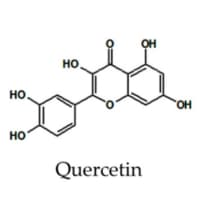
Quercetin is a plant flavonol from the flavonoid group of polyphenols. It is widely distributed among different fruits and vegetables.[1]
Dietary Sources
- Pomegranate
- Green tea
- Red onion
- Mango
- Moringa oleifera
- Blueberries
- Chicory
- Tomato
- Apple
- Passion Flower
- White mulberry
Safety[2]
- Poor aqueous solubility, extensive metabolism, and low oral bioavailability continue to limit clinical translation of quercetin.[3]
- Poor bioavailability limits clinical use and encourages advanced drug delivery strategies.[3:1]
- Future trials should validate standardized formulations, efficacy, and long-term safety.[3:2]
Healing Properties
Anti-Carcinogenic (anticancer)
Antiproliferative
Quercetin has demonstrated antiproliferative activity against colon and breast cancer cells.[4]
- Treatment of quercetin had reduced the proliferation rates of colon HCT116 and breat MDA-MB-231 cancer cells.[4:1]
Cancer chemopreventive agent
Treatment with quercetin dihydrate has been shown to promote the killing activity of T cells on cancer cells.[5]
The growth rate of tumor volumes and masses treated with quercetin dihydrate were decreased.[5:1]
- Quercetin regulates apoptosis and cell cycle progression through p53, PI3K/Akt, and mitochondrial signalling pathways, highlighting its relevance in cancer prevention and therapy.[3:3]
- Quercetin modulates PI3K/Akt and Wnt/β-catenin signaling pathways among its multitarget actions.[3:4]
Anti-Inflammatory
Strong antiinflammatory activity.[1:1]
- Quercetin exerts potent anti-inflammatory effects through modulation of multiple signalling pathways, including NF-κB.[3:5]
- Inhibition of NF-κB and MAPK suppresses the production of pro-inflammatory mediators.[3:6]
Anti-Infective
- Quercetin exhibits antiviral activity among its broad pharmacological effects.[3:7]
- Clinical studies further suggest that quercetin may provide therapeutic benefits in SARS-CoV-2 infection, although results remain heterogeneous.[3:8]
Antioxidant
Quercetin is one of the most potent antioxidants of plant origin.[1:2]
Quercetin has direct radical scavenging action.[1:3]
- Quercetin exerts potent antioxidant effects through modulation of multiple signalling pathways, including Nrf2, AMPK, and SIRT1.[3:9]
- Activation of Nrf2, AMPK, and SIRT1 enhances endogenous antioxidant defenses and maintains cellular redox homeostasis.[3:10]
- Quercetin modulates Nrf2, NF-κB, AMPK, SIRT1, PI3K/Akt and Wnt/β-catenin signaling pathways.[3:11]
Brain Health
Neuroprotective
Several in-vitro studies have reported that quercetin demonstrates neuroprotection.[1:4]
Quercetin’s metabolites after absorption have all been shown to afford neuroprotection as well.[1:5]
Quercetin protects against progressive dopaminergic neurodegeneration.[1:6]
Neuroregeneration
Quesrcetin stimulates neuronal regeneration.[1:7]
Antioxidant
It has been shown to protect neurons from oxidative damage while reducing lipid peroxidation.[1:8]
Anti-Inflammatory / Anti-Amyloid Fibrils
In addition to its antioxidant properties, it inhibits the fibril formation of amyloid-β proteins, counteracting cell lyses and inflammatory cascade pathways.[1:9]
- Suppresses neuroinflammatory processes by downregulating pro-inflammatory cytokines.[1:10]
- Prevents the degradation of acetylcholine, and decreases Aβ production.[1:11]
Cognitive performance
Quercetin restores acetylcholine levels through the inhibition of hydrolysis of acetylcholine by AChE enzyme.[1:12]
Memory Enhancer
Quercetin and rutin have been reported to function as memory enhancers in scopolamine-induced memory impairment tests, thus possibly enhancing cholinergic neurotransmission.[1:13]
Psychostimulant
Heart Health / Cardiovascular Health
Antiinflammatory
Quercetin Attenuates Atherosclerotic Inflammation[6]
Anti-Atherogenic
Quercetin inhibits atherogenesis (hardening/narrowing of the arteries).[6:1]
- Clinical studies suggest that quercetin may provide therapeutic benefits in cardiovascular disease, although results remain heterogeneous.[3:12]
Blood Health
Inhibits platelet aggregation.[1:14]
Metabolism
Energy Production / Mitochondrial Health
Quercetin protects against mitochondrial dysfunction.[1:15]
Quercetin stimulates mitochondrial biogenesis.[1:16]
- Quercetin ameliorates mitochondrial dysfunction by restoring mitochondrial membrane potential, decreases ROS production, and restores ATP synthesis.[1:17]
- It also increases the expression of AMP-activated protein kinase (AMPK), which is a key cell regulator of energy metabolism.[1:18]
- Quercetin modulates AMPK and SIRT1 signaling pathways relevant to cellular energy and redox homeostasis.[3:13]
Disease / Symptom Treatment
Cancer
Quercetin dihydrate has the exciting potential to be used as a cancer chemopreventive agent. Treatment with quercetin dihydrate has been shown to promote the killing activity of T cells on cancer cells.[5:2]
The growth rate of tumor volumes and masses treated with quercetin dihydrate were decreased.[5:3]
Colorectal Cancer
A systematic review and meta-analysis of preclinical studies found that quercetin exerts beneficial effects across multiple facets of colorectal cancer (CRC) treatment.[7]
- Quercetin treatment significantly reduced the incidence of CRC (SMD -1.22, p = 0.004) compared to control groups.[7:1]
- Quercetin alleviated inflammation and oxidative stress in colorectal cancer models.[7:2]
- Quercetin effectively improved the degree of crypt lesions and alleviated precancerous lesions (SMD -1.40, p = 0.02).[7:3]
- Quercetin demonstrated significant inhibitory effects on tumor cell proliferation as determined by PCNA analysis (SMD -8.22, p < 0.00001).[7:4]
Chronic Obstructive Pulmonary Disease (COPD)
- Clinical studies support benefits of quercetin in COPD, although results remain heterogeneous.[3:14]
Diabetes
- Clinical studies support benefits of quercetin in diabetes, although results remain heterogeneous.[3:15]
Hyperuricemia
- Clinical studies support benefits of quercetin in hyperuricemia, although results remain heterogeneous.[3:16]
Sarcoidosis
- Clinical studies further suggest that quercetin may provide therapeutic benefits in sarcoidosis, although results remain heterogeneous.[3:17]
SARS-CoV-2 / COVID-19
- Clinical studies further suggest that quercetin may provide therapeutic benefits in SARS-CoV-2 infection, although results remain heterogeneous.[3:18]
Neurodegenerative Diseases
Quercetin Disaggregates Prion Fibrils and Decreases Fibril-Induced Cytotoxicity and Oxidative Stress.[8]
- A 2026 review reports neuroprotective activities of quercetin among its multitarget effects in oxidative stress-related and neurodegenerative conditions.[3:19]
Neuroinflammation
Reducing the neuroinflammatory events in microglia might afford a beneficial strategy for the prevention of the progression of inflammatory-mediated neurodegenerative disorders.[1:19]
Quercetin has been reported to have anti-inflammatory actions, and is a suitable candidate among phytochemicals for future studies on its efficacy to reverse neuroinflammation.[1:20]
Quercetin has been shown to inhibit neuroinflammation by reducing nitric oxide production, iNOS gene expression in microglia, the production of inflammatory cytokines, as well as a reduction in cytokine expression as reported from in vivo studies.[1:21]
Alzheimer’s Disease (AD)
- Reverses histopathological hallmarks of AD[1:22]
- Improves motor function[1:23]
- Reduces α-synuclein fibrillization[1:24]
- Reduces hippocampal neuronal cell death[1:25]
- Improves synaptic plasticity[1:26]
- Quercetin has shown therapeutic efficacy, improving learning, memory, and cognitive functions in AD.[1:27]
- Quercetin administration reverses extracellular β-amyloidosis and decreases tauopathies, astrogliosis, and microgliosis in the hippocampus and amygdale, thus protecting cognitive and emotional function in age triple transgenic Alzheimer’s disease model.[1:28]
Quercetin interferes with the formation of neurotoxic oligomeric Aβ species and displays fibril destabilizing effects on preformed fibrillar Aβ, reversing Aβ-induced neurotoxicity.[1:29]
Parkinson’s Disease
Dopaminergic Neurodegeneration
Quercetin protects against progressive dopaminergic neurodegeneration.[1:30]
Cognitive Impairment
Ischemia
Traumatic injury (brain/spinal)
Isoquercetin improved motor functions in acute spinal cord injury.[1:31]
Huntington’s disease
Synergistic Effects
Nicotinamide adenine dinucleotide (NAD+)
Cell Protection (Helps prevent DNA damage)
Quercetin can significantly potentiate the cell protection and rescue effects of Nicotinamide adenine dinucleotide (NAD+).[9]
Quercetin has been independently shown to significantly protect cells from DNA-damaging agents and induced cell death.[9:1]
The NAD+ precursors Nicotinic acid and Nicotinamide, when administered with Quercetin significantly improved cell protection and rescue effects, plausibly due to increased intracellular NAD+ levels.[9:2]
Title: Neuroprotective Effects of Quercetin in Alzheimer’s Disease
Publication: MDPI Biomolecules
Archive: archive, archive-mirror ↩︎ ↩︎ ↩︎ ↩︎ ↩︎ ↩︎ ↩︎ ↩︎ ↩︎ ↩︎ ↩︎ ↩︎ ↩︎ ↩︎ ↩︎ ↩︎ ↩︎ ↩︎ ↩︎ ↩︎ ↩︎ ↩︎ ↩︎ ↩︎ ↩︎ ↩︎ ↩︎ ↩︎ ↩︎ ↩︎ ↩︎ ↩︎Title: Safety Aspects of the Use of Quercetin as a Dietary Supplement
Publication: Wiley Online Library: Molecular Nutrition & Food Research
Archive ↩︎Title: From antioxidant to signal modulator: The expanding role of quercetin in human health
Publication: Pharmacological Research - Natural Products
Date: 2026/09/01
Study Type: Review
Author(s): Aman Kumar, Nayan Sood, Ritik Kumar Thakur, Nitin Singh, Rajneesh Kalyan, Preeti Patel, Balak Das Kurmi
Abstract: Quercetin, a naturally occurring flavonoid widely distributed in fruits, vegetables, and medicinal plants, has attracted considerable attention as a safe and affordable therapeutic candidate for the prevention and management of lifestyle and age-related diseases. Extensive evidence demonstrates that quercetin exerts potent antioxidant, anti-inflammatory, antiviral, chemoprotective, and immunomodulatory effects through modulation of multiple signalling pathways, including Nrf2, AMPK, SIRT1, NF-κB, Wnt/β-catenin, and p53. Clinical studies further suggest possible benefits in COPD, sarcoidosis, hyperuricemia, cardiovascular disease, and SARS-CoV-2 infection, although results remain heterogeneous. Poor aqueous solubility, extensive metabolism, and low oral bioavailability continue to limit clinical translation.
Source URL: https://www.sciencedirect.com/science/article/abs/pii/S2950199726003496
DOI: 10.1016/j.prenap.2026.100836 ↩︎ ↩︎ ↩︎ ↩︎ ↩︎ ↩︎ ↩︎ ↩︎ ↩︎ ↩︎ ↩︎ ↩︎ ↩︎ ↩︎ ↩︎ ↩︎ ↩︎ ↩︎ ↩︎ ↩︎Title: Synthesis, Antiproliferative Activity and Radical Scavenging Ability of 5-O-Acyl Derivatives of Quercetin
Publication: MDPI - Molecules
Archive: archive, archive-mirror ↩︎ ↩︎Title: Quercetin inhibiting the PD-1/PD-L1 interaction for immune-enhancing cancer chemopreventive agent
Publication: Wiley Online Library: Phytotherapy Research
Archive ↩︎ ↩︎ ↩︎ ↩︎Title: Quercetin Attenuates Atherosclerotic Inflammation by Inhibiting Gal‐3‐NLRP3 Signaling Pathway
Publication: Wiley Online Library ↩︎ ↩︎Title: The potential value of quercetin for colorectal cancer: a systematic review and a meta-analysis of preclinical studies
Publication: Frontiers in Pharmacology
Date: 2025/09/05
Study Type: Systematic Review and Meta-Analysis (preclinical animal studies)
Author(s): Duan, Xiucheng, Zhang, Liyuan, Liu, Fenye ↩︎ ↩︎ ↩︎ ↩︎ ↩︎Title: Quercetin Disaggregates Prion Fibrils and Decreases Fibril-Induced Cytotoxicity and Oxidative Stress
Publication: MDPI - Pharmaceutics
Archive: archive, archive-mirror ↩︎Title: Resveratrol and Quercetin Potentiate the Cell Protection and Rescue Effects of NAD+ Precursors in HEK293 Cells Challenged by DNA Damaging Agent, N-Methyl-N′-nitro-N-nitrosoguanidine
Publication: Sage Journals: Natural Product Communications
Date: September 24, 2021
Archive ↩︎ ↩︎ ↩︎